The 2-3-4 Breathing Technique for Riding Anxiety
If you've ever felt your chest tighten at the mounting block, or noticed your hands gripping the reins a little too hard before you've even walked off, you already know anxiety doesn't wait for a convenient moment. It shows up while you're driving to the yard, at the gate or tacking up.
The 2-3-4 breathing technique is one of the tools I teach in my Stop Anxiety, Enjoy Riding workshop, and it's one you can use anywhere, with no equipment, and no one around you needing to know you're doing it. Here's exactly how it works, and why it works.
Why breathing changes how you feel, not just how you look
To understand why this technique helps, it's worth knowing a little about your nervous system.
You have two main settings running in the background: your sympathetic nervous system and your parasympathetic nervous system.
Your sympathetic nervous system is your fight, flight or freeze response. It fires the moment your brain decides there's a threat, real or not. Heart rate up, breathing shallow and fast, blood diverted away from digestion and towards your muscles. It's brilliant if you're genuinely in danger. It's exhausting if it switches on every time you go near a horse.
Your parasympathetic nervous system is the opposite. It's your rest and digest state, where your heart rate settles, your muscles unclench, and your thinking brain comes back online.
You can't think your way from one to the other. Telling yourself to calm down rarely works, because the sympathetic state isn't a thought; it's a physical one. But you can breathe your way there. Breathing out for longer than you breathe in signals to your body that the danger has passed, and starts pulling you back towards the parasympathetic state. That's the engine behind the 2-3-4 technique: in for 2, hold for 3, out for 4. The out breath is the longest part on purpose.
What is a meridian point, and why does tapping help?
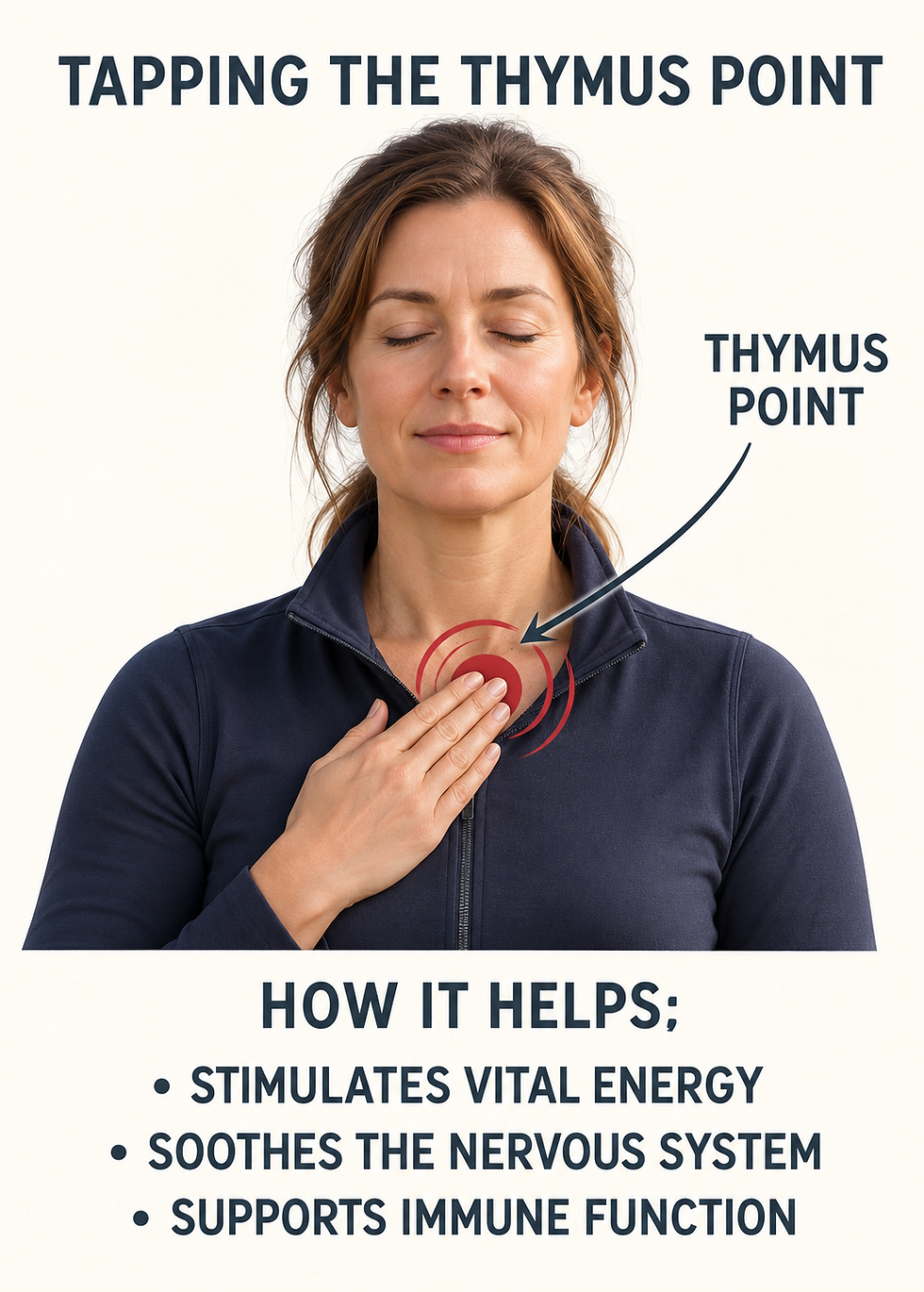
The 2-3-4 technique also asks you to tap your thymus point, a spot in the centre of your upper chest, just below where your collarbones meet, continually while you breathe.
The thymus point sits on what's known in Traditional Chinese Medicine as a meridian, one of the body's energy pathways, thought to connect to your nervous system and organs. Tapping specific points like this is believed to interrupt the signal between your brain and your body, the same signal currently telling you that you're under threat. It also gives your mind something simple and physical to focus on, which pulls your attention away from the spiral of anxious thoughts that would otherwise keep the sympathetic response going.
In short: the breathing shifts your physiology, and the tapping interrupts the thought loop feeding it. Together, they work faster than either one on its own.
How to do the 2-3-4 breathing technique
Use this the moment you feel the fear building, whether that's while you're tacking up, standing at the gate, or are just about to head to the mounting block.
Scale the intensity of the emotion, from 1 to 10. This gives you something to measure against afterwards.
Set a clear intention. Something as simple as "I want to release this now" is enough.
Relax your jaw and drop your tongue. This interrupts your inner dialogue and helps you focus.
Find your thymus point, in the centre of your chest, and tap it continually with one hand, in an even rhythm. Keep this going for the rest of the process.
Breathe in through your nose for 2 seconds.
Hold the breath for 3 seconds.
Breathe out through your mouth for 4 seconds.
Repeat, for as long as you need, until your body settles back into balance.
That's it. No equipment, and nothing anyone watching would even notice.
When to use it
This isn't only for the big moments. Use it the second you notice the familiar tightness building, rather than waiting until you're fully overwhelmed. It's far easier to bring your nervous system back from a 4 than from a 9. With practice, most people find they need fewer rounds each time, because the body starts to recognise the pattern and settle faster.
Want more than one technique?
The 2-3-4 breathing technique is one of several tools I teach live in Stop Anxiety, Enjoy Riding, alongside why this happens in the first place and what to do about the thoughts that won't switch off once the fear itself has eased. Find out more.